Thought Club: a podcast about how people actually learn, and free resources for when your brain won't cooperate


Every mind learns differently. This was built around that fact.
A podcast about how learning actually works, and a free library for the days your brain declines to participate.
Good to see you again, .
Pick up where you left off, or wander somewhere completely different.
The podcast
How learning actually happens, told by people who pay attention to it.
Conversations with a developmental pediatrician, a Simpsons writer, a mindfulness coach, and a professional illusionist. Different jobs, same question: what is actually going on when a person learns something? Most episodes run under half an hour.

Learning Assessments: Building a Roadmap to Your Brain
Dr. Paul Yellin has spent a career explaining what an assessment can and cannot tell you. Mostly it tells you about the particular brain in front of him, which is the only one anybody actually has.

Comedy: Learning Through Laughter
The funniest teacher you had was probably also the one you remember. Simpsons writer Mike Reiss explains why that is not a coincidence, and makes a serious case for jokes.

Mindfulness: The Unexpected Meaning-Making of College Admissions
College admissions has become an extremely efficient machine for producing panic. Neil Benjamin argues it is also one of the few moments anyone asks a teenager who they actually are.
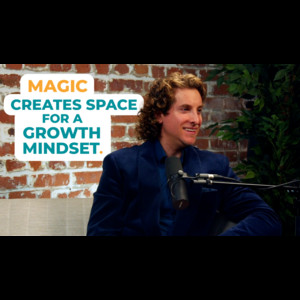
Magic: Cultivating Curiosity Through Illusion
There is a specific moment when you realize you have no idea how something just happened. Illusionist Matias Letelier has built a career on that moment, and thinks it is the good part.
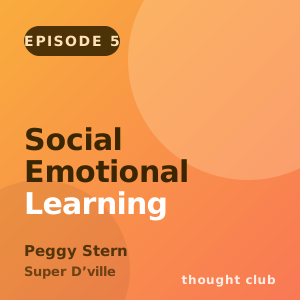
Social Emotional Learning: What Neurodivergent Kids Have to Teach Us
Peggy Stern won an Academy Award, then built a children's show and curriculum around neurodivergent kids. Super D'ville became a hit. It turns out those kids had the clearest things to say about handling feelings.
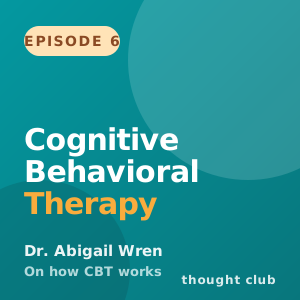
Cognitive Behavioral Therapy: Clarifying the Thoughts that Become Feelings and Actions
CBT gets described as therapy for people in crisis. Dr. Abigail Wren explains how it actually works, and why the underlying idea is useful even when nothing in particular is wrong.
Resources
Start with whatever is currently in your way.
Focus, organization, big feelings, school, relationships, work. You don't need to fix your entire life before dinner. Pick the one thing making today harder than it needs to be and start there.
From the feed
Short, sourced ideas from our Instagram. Every one of them leads somewhere you can actually go next.
Stress may be a less reliable villain than advertised. Researchers have found that how you think about stress changes what it does to your body and your performance.
See what shifts → Did you know?Learning something physically changes your brain. The word for it is neuroplasticity, and it means the phrase "changed my mind" is more literal than it sounds.
Nineteen more, each with a source → ResearchResearchers are still working out what hours of scrolling does to memory and attention. Early findings are not flattering to the phone.
Try the experiment → Quote"Wonder is the beginning of wisdom."
— Socrates
Set a timer for five minutes and start the thing you've been avoiding.
Good. Five minutes. Not a new personality. Not a complete life overhaul. Five minutes.
Time's up. Stop there or keep going. Either way the starting part is done.
A short note, only when it's worth your time
One email when there's a new episode or something genuinely worth reading. No drip campaign, no funnel. Unsubscribe in one click.